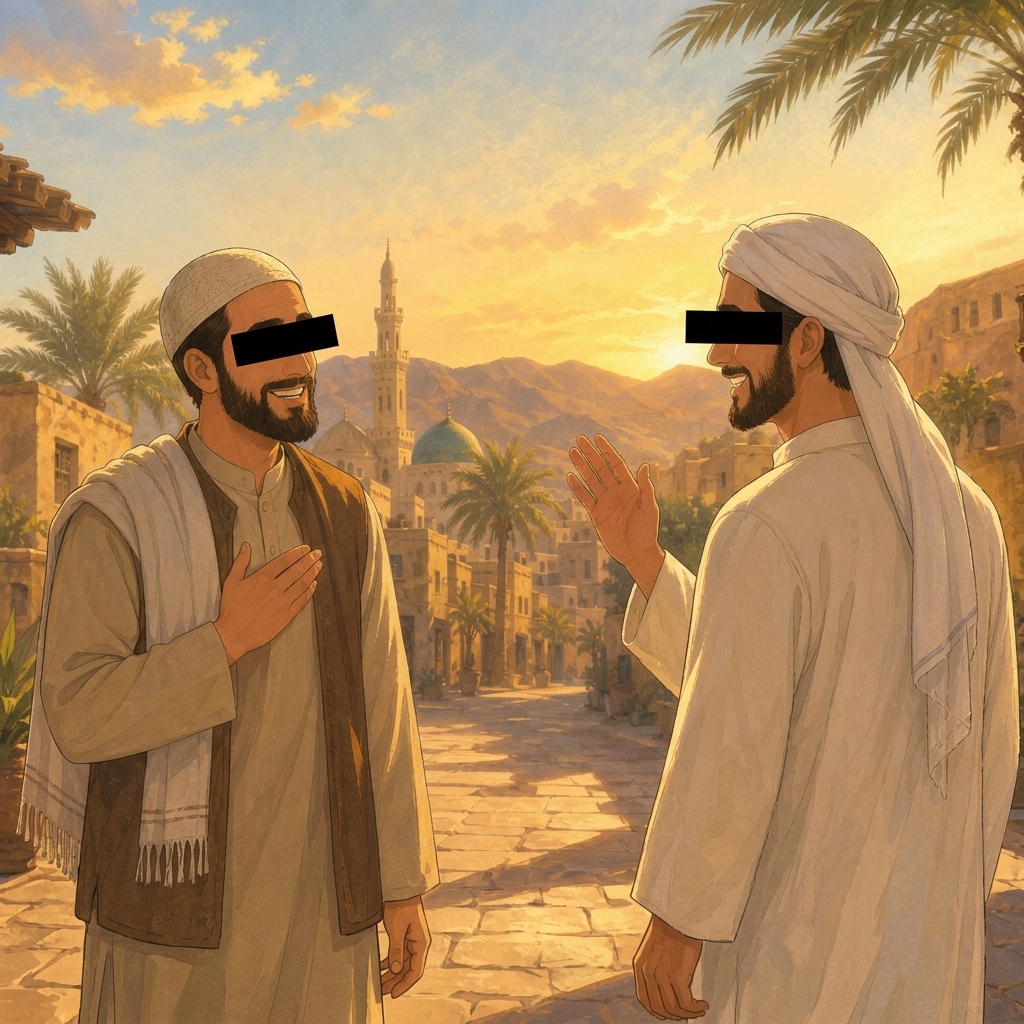

Excerpt from the book Why Are Muslims Backward While Others Have Progressed? by Chakib Arslan
The Causes Behind the Supremacy of Muslims in the Past
The causes that raised Muslims to such a position of supremacy were, broadly speaking, due to the Islamic religion that had just appeared in the Arabian Peninsula. Once adopted by the Arab tribes, this new religion guided them from division to unity, from ignorance to civilization, from harshness to mercy, and from the worship of idols to the worship of the One. It brought about a complete renewal of their persons and led them onto the paths of power, security, glory, recognition, and self-sufficiency. To the point that, in half a century, they were able to conquer half the planet. And had it not been for the discord that reappeared among them during the final years of the caliphate of 'Uthman and during that of 'Ali, they would have conquered the whole world and no one would have been able to stand against them.
The Muslim victory in the regions they managed to conquer in a period of time not exceeding half a century, or two-thirds of a century, and this despite the fighting caused by the dispute between Mu'awiya and 'Ali, and the fighting that took place between the Umayyads and Ibn al-Zubayr, astonished wise men, historians, intellectuals, and great conquerors such as Napoleon Bonaparte, the greatest among them.
Las Cases, who accompanied him on the island of Saint Helena, reports from him a statement on this matter, as do many other chroniclers of the events of Napoleon Bonaparte's life. It is indeed established in a way that leaves no room for doubt, through the words of this great conqueror and through his biography during his stay in Egypt, that he held great admiration for the Prophet Muhammad ﷺ, for 'Umar رضي الله عنه, and for many other heroes of Islam, and that he had even thought of converting to Islam during his time in Egypt.
The Quran thus reshaped the Arabs under a new light. It in a sense recreated them, and brought them out of the Arabian Peninsula with the sword in one hand and the Book in the other, to conquer, dominate, and establish themselves across the earth.
There is no reason to ignore what is said about the Arabs before Islam, nor what is reported regarding their conquests, their ancient civilizations, and their virtuous manners during the period of ignorance. The existence of all of this has been established and is not the subject of any controversy; its traces are still visible. The civilization of the ancient Arabs is not in doubt and is among the oldest civilizations in the world.
Among the elements tending to prove that writing appeared among the Arabs is the fact that the sphere of civilization was limited to the Arabian Peninsula and the neighboring regions. And even if one were to prefer the hypothesis that the Phoenicians were at the origin of this discovery, they were in reality only a Semitic and Arab people.
At a certain time, the Arabs suffered domination and humiliation at the hands of foreign peoples on their own lands. This was the case, for example, with the Persians in Yemen, Oman, and al-Hira, the Abyssinians in Yemen, and the Byzantines on the edges of the Arabian Peninsula and in al-Sham. The Arabs in reality only regained their full and true independence with the advent of Islam.
Without Muhammad ﷺ, distant peoples would not have known them, mighty kingdoms, Caesars, and Khosrows would not have submitted to their authority, people would not have spoken of their military exploits, and they would not have occupied within history the place that is theirs and that carried them to the front rank of conquering peoples.
It is incumbent upon us to aim for and diligently search for that cause which allowed the Arabs to rise, to conquer lands for Islam, to dominate their enemies, and to reach the heights of glory. Can it be said that this cause is still present among the Arabs who, despite the existence of that very cause, fell behind, as did their followers from among the rest of the Muslims? Or has this cause disappeared from among them, so that nothing remains of faith but its name, nothing of Islam but its traces, and nothing of the Quran but its recitation without any respect for its injunctions, along with many other aspects that were present in the earliest days of this community and during the era of the greatness of the sharia?
Interested in our programs?
Contact us to learn more about our learning packages in Madinah.
 WhatsApp